I have spent most of my career thinking about software from an engineering perspective.
A new requirement would come in, I would understand it, design the system, choose the right tools, write the code, and ship it.
That approach worked well for a long time.
But as the projects became larger and more ambiguous, I started running into a different kind of problem.
The difficult part was often not writing the code.
It was figuring out what we should actually build.
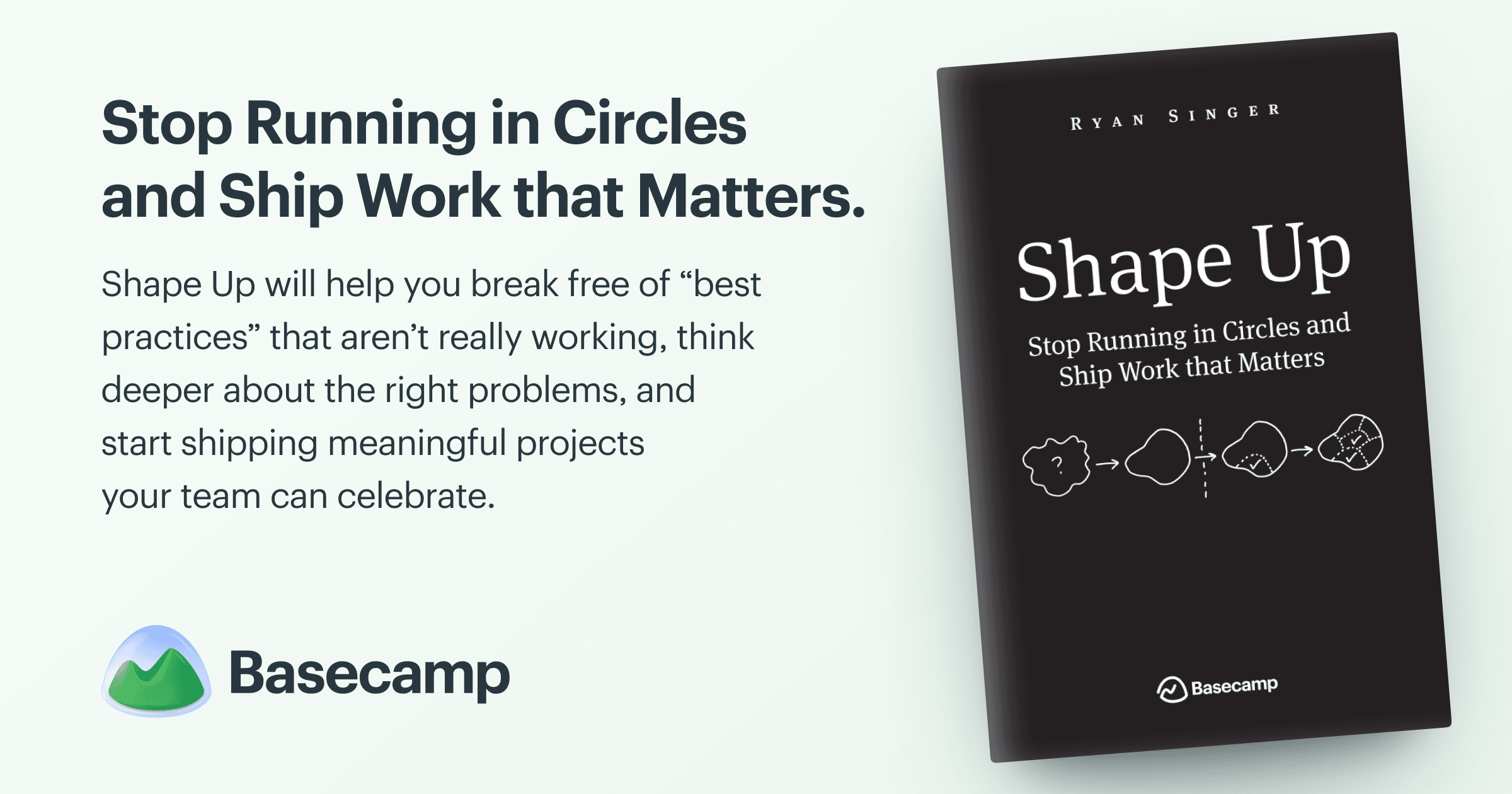
That is how I came across Shape Up by Ryan Singer of Basecamp.
Shape Up is presented as a guide to product development at Basecamp, but I think developers can get a lot from it too. The book is built around a simple idea: before asking a team to build something, spend enough time shaping the problem so that the team can make meaningful progress without being buried in unnecessary scope and uncertainty. Basecamp organizes the approach around three parts: shaping, betting, and building.
What I liked most was that it did not try to make software development more complicated.
It actually tried to remove some of the complexity.
The basic idea behind Shape Up
The easiest way I can describe Shape Up is this:
Don’t start with a long list of tasks.
Start by understanding the problem, deciding how much of it is worth solving, shaping a possible solution, identifying the risky parts, and then giving the team enough room to build it.
That process has a few ideas that stood out to me.
Shape the work before building it
Shape Up argues that work should be shaped at the right level of detail.
Too much detail too early becomes a specification that leaves little room for engineering and design decisions. Too little detail leaves the team with a vague problem and no useful direction. The goal is something that is rough enough to leave room for discovery, but solved and bounded enough to be buildable.
This sounds obvious, but it is surprisingly easy to get wrong.
As developers, we often receive requirements that are either too vague or already too specific.
Shape Up made me think more carefully about the space in between.
Appetite instead of estimates
This was probably the idea I found most useful.
Shape Up uses the concept of an “appetite”.
Instead of starting with:
“How long will this feature take?”
the question becomes:
“How much time are we willing to spend solving this problem?”
The important distinction is that the time is fixed while the scope can change. Basecamp describes small and big batches, with the larger projects fitting into a six-week cycle.
This changes the conversation completely.
If something is worth two weeks of work, you don't keep adding requirements until the estimate becomes four weeks.
You ask:
“What is the most useful version we can build within those two weeks?”
That is a much healthier way to think about scope.
Find the rabbit holes early
Another idea I liked was the focus on “rabbit holes”.
These are technical unknowns, design problems, or dependencies that can completely derail a project once development has already started.
The book makes a strong case for finding these risks before committing to the project.
This is especially relevant to engineering.
A project can look like a simple feature until one part of it turns out to require a completely different architecture, a difficult integration, or a solution nobody has actually figured out yet.
Good product development is not about pretending these unknowns don't exist.
It is about finding the important ones early.
Betting instead of planning everything
Shape Up also has a different way of thinking about planning.
Instead of building a giant roadmap and assigning work months in advance, Basecamp works in cycles and makes deliberate bets about what deserves attention next. Their standard cycle is six weeks, followed by a period of “cool-down”.
The word “bet” is important.
A bet has a potential payoff, but it also has a limit on the downside.
If you decide to spend six weeks on something, six weeks is the maximum you are committing to it. If it is still not worth shipping after that, the answer is not automatically “let's give it another six weeks”.
That creates a useful forcing function.
It makes teams decide what is actually worth building.
The part that mattered most to me: applying it to ExplodX360
Shape Up came to the rescure when I was working on ExplodX360, a multi-tenant field marketing platform I was responsible for developing end-to-end.
The project involved much more than building a few screens.
It had campaign management, client and promoter management, scheduling, field operations, footfall tracking, OCR-based workflows, and a mobile application for on-ground teams.
At the beginning, the natural tendency was to think in terms of features.
We need this screen.
We need this workflow.
We need this dashboard.
We need this mobile functionality.
And because there were many moving parts, it was easy for the scope to grow faster than the product itself.
Reading Shape Up gave me a better way to look at the problem.
Instead of treating every requirement as something that automatically needed to be built, I started thinking about the actual workflow we were trying to improve.
What does the marketing team need to accomplish?
What does a promoter need to do in the field?
Which information actually needs to be captured?
Which parts need to be automated?
Which features are important now, and which can wait?
That change in thinking helped me simplify the work.
Scope became a design decision
One of the biggest lessons I took from the book was that scope is not just a project-management concern.
It is part of product design.
When the available time is limited, you have to decide what matters most.
For ExplodX360, this meant thinking about the complete workflow instead of trying to build every possible feature around it.
The goal was not to create the most feature-rich field marketing system possible.
The goal was to create a useful system that could actually support the way the team worked.
That sounds like a small distinction, but it changes a lot of engineering decisions.
It also changed how I think about architecture
There was another lesson I took from Shape Up that I did not expect.
Good architecture is not only about making the system technically elegant.
It should also make the product easier to evolve.
When requirements are still changing, over-engineering too early can be just as dangerous as under-engineering.
Shape Up's emphasis on shaping, boundaries, and identifying risks helped me think more carefully about where to be precise and where to leave room for implementation decisions later.
That is particularly useful when working on products where you are responsible for the entire lifecycle, from the initial idea to production.
What I took away from Shape Up
I don't think you need to adopt Shape Up exactly as Basecamp describes it.
That is not even the point of the book.
What I took from it is a set of useful questions:
What problem are we actually solving?
How much is this problem worth solving right now?
What is the smallest useful version?
What are the risky or unknown parts?
What should we explicitly not build?
What would make this project worth shipping?
Those questions are useful whether you have a five-person startup, a large engineering team, or you are building a product yourself.
Final thoughts
What I liked most about Shape Up is that it changed the way I think about my role as a developer.
Building software is not only about turning requirements into code.
The more responsibility you take for a product, the more time you spend deciding what should be built, what should not be built, where the real risks are, and how much complexity is actually justified.
That is the part of software development I have become increasingly interested in.
Shape Up gave me a useful vocabulary and a practical framework for thinking about it.
I would recommend it especially to developers who are moving toward more ownership of the products they build.
You can read Shape Up for free on Basecamp's website. It is one of the few software books I've read where I came away thinking less about process and more about how to make better product decisions.